Fig Tree Analogy

A reflection by Mother Maria-Michael Newe, OSB

We are so blessed to have Mary as our Mother, our Queen Mother, whose joy it is to intercede for God’s people.  She’s a Mother who understands us – Mary knows us, our history, our situation, and what our deepest needs are.  She knows what God poured into us at our conception, and with what excitement the Trinity beheld each one of us and wondered, “What will she do with this?  How will she live these gifts out?”  

It reminds me of how the other day I was so thrilled to pick a little fig off of our fig tree.  What a joy!  It makes me think of how God sees us: The whole tree can be full of figs, but He picks one and is so joyful over it.  Each one is a joy when you pick it.  Each one is a joy when you see it.  And you, too, are a joy for God.  You, too, have a “yes”.  You, too, have gifts poured into you; so acknowledge them, and then run to Christ and say, “Thank you.”  Because then not only will Mary intercede for us, but she will also be able to tell God of our gratitude.

The Loving Heart of my God thought of my soul, loved it, and prepared endless means to promote its salvation, even as though there were no other soul on earth of which He thought; just as the sun shines on each spot of earth as brightly as though it shone nowhere else, but reserved all its brightness for that alone. So Our Dear Lord thought and cared for every one of His children as though none other existed. “Who loved me, and gave Himself for me,” St. Paul says, as though he meant, “for me alone, as if there were none but me He cared for.”

Saint Francis de Sales

Ecce, Venio

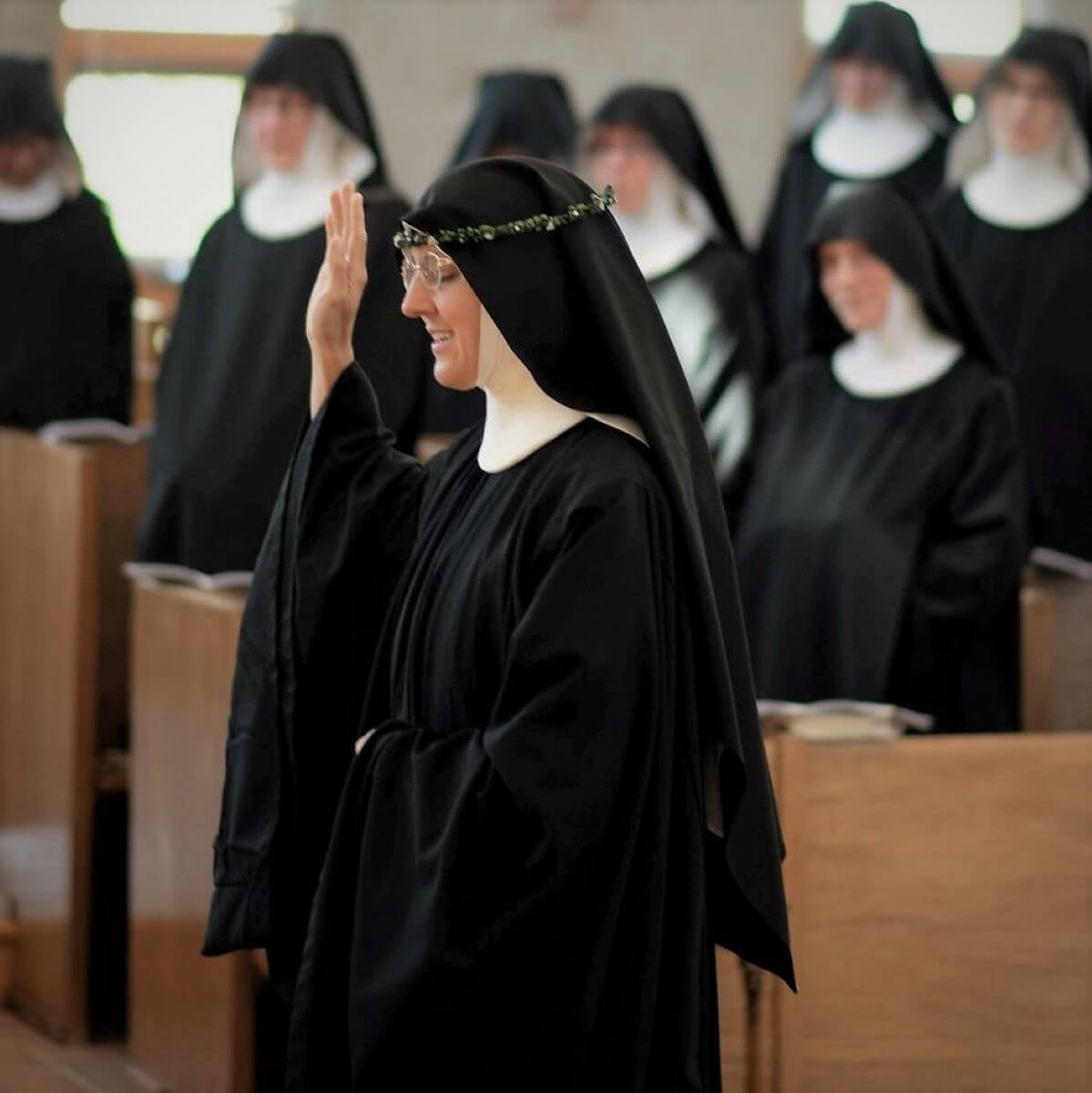
A reflection by Mother Maria-Michael Newe, OSB, given to the community on the day before Sister Assunta made her solemn monastic profession, highlighting her profession motto: “Ecce, venio” – “Behold, I come” 

Tomorrow, on the Feast of Saint Mary Magdalene, our Sister Assunta will make her solemn monastic vows.  It is fitting to claim that Saint Mary Magdalene has the characteristics of a true Benedictine (even though Benedict had not yet arrived on earth during her lifetime!).  She clearly has the spirit that Benedict valued in his monks, to “prefer nothing to the love of Christ” (Rule of St. Benedict, 4.21).  It’s as if she cried out in her heart, “Ecce, venio” – “Behold, I come” – when she was one of the only disciples, except for John, present for Christ’s crucifixion, when she prepared the spices for His burial, and when she searched for her Beloved at His empty tomb.  The Song of Songs can be applied to her when it says, “Have you seen him whom my soul loves?” (Song 3:3).  She had that earnest searching of the heart, that earnest desire to be with Christ.  Saint Mary Magdalene is outstandingly known for her unquestionable love for Christ, and His great love for her.  Similarly, Sister Assunta is about to profess her monastic vows to become more like the One she loves, to embrace more fully the One she seeks above all, the One who has laid down His life for her and says, “Ecce, venio,” – “Behold, I come.”  

Dear Sister Assunta, tomorrow a gold ring will be placed on your finger.  And this is what will be said by the Archbishop to you: “Receive the ring of faith, the seal of the Holy Spirit, that you may be called the spouse of God.  You are betrothed to Jesus Christ, the Son of the Most High Father.  May He keep you undefiled in his love.  Serve Him faithfully, that you may one day be crowned eternally.  In the Name of the Father and of the Son and of the Holy Spirit.”  Look often at your ring, and remember well to Whom you are wed.  Love Him without ceasing, as Mary Magdalene did.  That is our prayer for you.  Keep your eyes on eternity.  Life is short, but you will never regret what you do if you love Christ most of all.  We can wish you nothing better.

Our Sister Assunta, OSB, professed her solemn monastic vows on July 22, 2023.  Adding to the already glorious occasion of the Feast of Saint Mary Magdalene, Sister Assunta’s profession day was a truly blessed and joyous one, and we were happy that so many of her family members from Texas were able to join us for the celebration. Below are some of the photos of Sister Assunta’s profession.

Photos by Ellie Lempe


The Trouble with Birds

A reflection by Mother Maria-Michael Newe, OSB

“A sower went out to sow his seed. And as he sowed, some seed fell on the path and was trampled, and the birds of the sky ate it up…And some seed fell on good soil, and when it grew, it produced fruit a hundredfold… Whoever has ears to hear ought to hear.”

Luke 8: 5, 8

Photos of birds at the Abbey of St. Walburga

We hear in Luke’s Gospel about the parable of the sower.  As I was thinking about this reading, I thought about how birds usually just peck at one thing at a time.  Isn’t that what happens to us in life?  The “birds” peck away at the time we have to spend with God.  They just take one minute at a time.  It’s like when you sit down to do lectio divina and realize that your books are out of place, so you put them back in order – and there goes one seed.  And then you see that your bed isn’t made yet, and there goes another couple seeds.  And then you’re sitting there drinking your coffee and reading the Word, and then of course you notice a stack of papers that are in the wrong place, so you think you’ll just get them put away quickly, but then there’s another seed gone.  Pretty soon, practically all the seeds have been eaten up!  You’ve been in your room alright, but what have you been doing there?  All those little things that are so hard not to pay attention to. 

And I pondered how often this happens to us throughout the day, too.  “Acedia” doesn’t mean that you don’t work, but that you’re doing the things you’re not supposed to be doing.  How many times do you find yourself running hard in the opposite direction from what you’re really supposed to be doing?  In the moment, it seems that “Anything else is better than what I’m supposed to be doing right now.”  And yet, being attentive to our present duty it is what God is calling us to.  And that takes a great deal of discipline, just to do what you’re supposed to do.  Everything else is like the little ravens that are running around picking up the seeds, taking the minutes away from doing what we should be doing.  All those little distractions steal from us our time with God, and we should be on guard against them. 

I wonder if Martha was tempted by the birds during the dinner at Bethany, when she was busying about with every possible detail of hospitality? Jesus gently reprimanded her to not be so anxious, and that her sister had chosen the “better part” by sitting at His feet.  But it seems that Martha took His correction without any bitterness, because we know that she was the first one to come out and meet Jesus when He came to raise Lazarus from the dead.  She wasn’t hiding somewhere because she was ashamed of being reprimanded.  What a humble soul she must have been.  I pray that if we find ourselves tempted by the birds, we will have the courage to turn back to Christ and look to Him for help and guidance.

More photos of birds at the Abbey of St. Walburga

My Lord and My God

A reflection by Mother Maria-Michael Newe, OSB

This year our community has adopted the practice of all-day exposition of the Blessed Sacrament on Mondays, with the particular intention of praying for our Holy Father and for priests.  Spending extra time in adoration is like giving the widow’s mite, because as everyone knows, time is one of the most precious things to us.  So when we give the little that we have, it is no small thing.  

It’s so difficult today to be a priest, and equally so to be a religious.  It’s just not so valued, and it’s even fought against.  And so we need to pray, because we are the heartbeat of the Church with our prayer.  A strong heart brings gives to all the members; without that, major organs die.  That is how important our prayer is.  So when you go to adore Christ in the Eucharist, it makes no difference if you feel glorious about it or if you feel just the opposite; the important part is just being there.  Whatever prayer Christ puts in your heart – if you say the rosary, if you just sit there and be with Him, if you read the Scriptures – whatever it be, do it wholly.  Even if you sit there and just repeat the words of St. Thomas, “My Lord and my God,” that would be enough.  But let your heart say it.  And the priests, our pope, in their hearts will hear that heartbeat.  May we help it to beat strong.

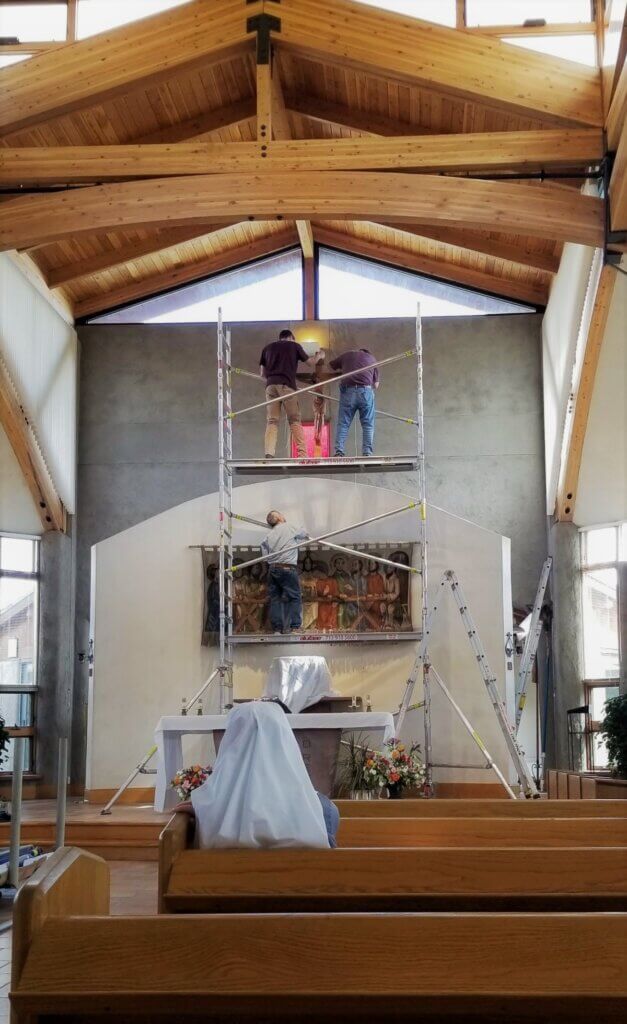
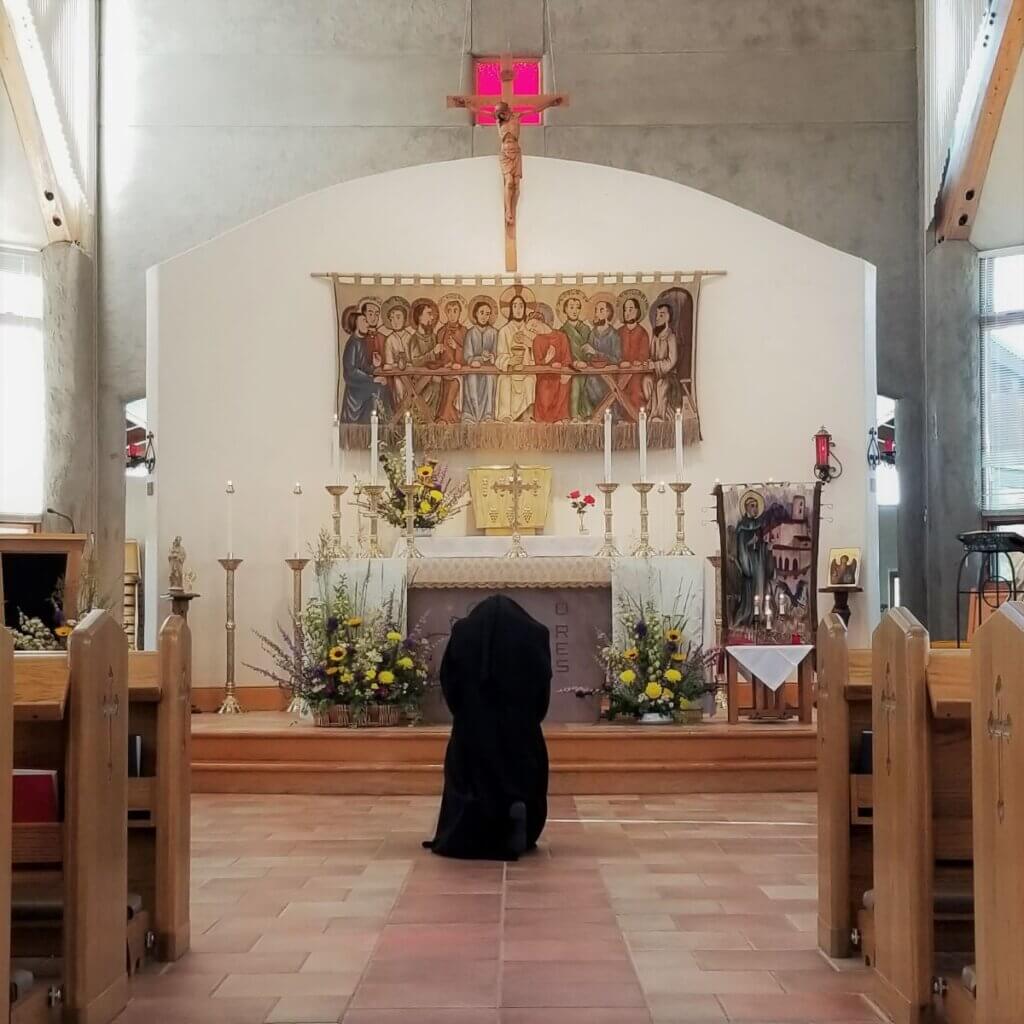
About the photos: In honor of the National Eucharistic Revival (running from Corpus Christi 2022 to Pentecost 2025), we recently changed the décor of our chapel, hanging behind the tabernacle the tapestry of the Last Supper.  This tapestry, hand woven by a nun at our motherhouse in Germany, was originally in our chapel at Boulder, but when we moved to Virginia Dale it would not fit in the space along with our large clay crucifix.  But by replacing that large crucifix with the smaller one we had been using in our refectory, we were able to have the Last Supper tapestry return to the chapel sanctuary.

St. John the Baptist’s Humility

A reflection for the Solemnity of the Nativity of St. John the Baptist by Mother Maria-Michael Newe, OSB

“The one who has the bride is the bridegroom; the best man, who stands and listens for him, rejoices greatly at the bridegroom’s voice.  So this joy of mine has been made complete.  He must increase; I must decrease.”

St. John the Baptist speaking of Jesus in John 3:29-30

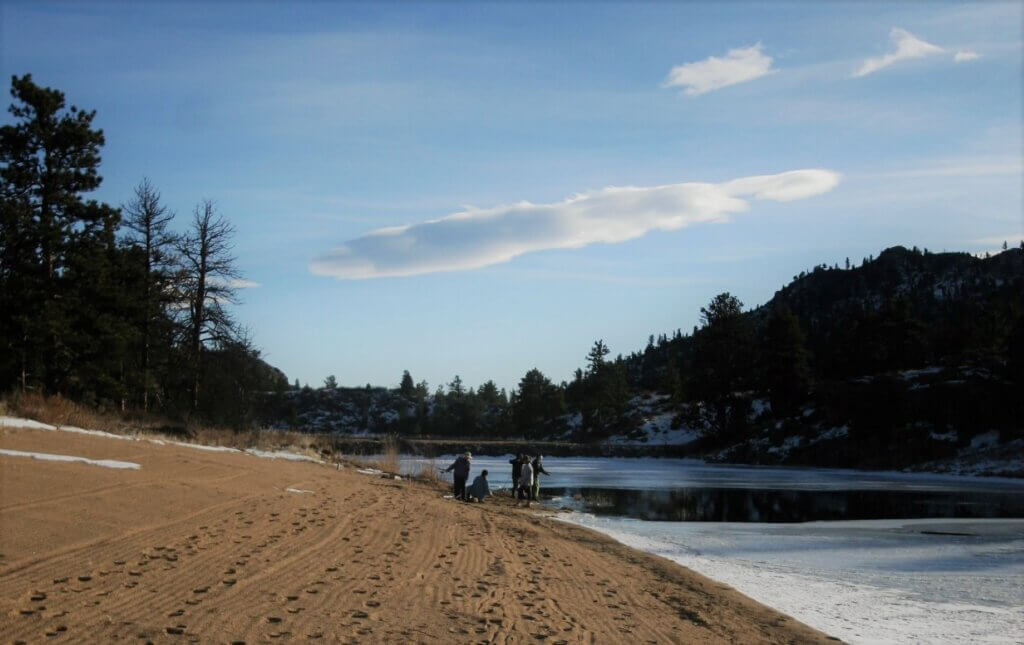
Nuns of the Abbey of St. Walburga fishing at a nearby reservoir, reminiscent of John’s mission field: baptizing in the Jordan River

John the Baptist must have been a very humble man.  Everyone surely knew the story surrounding his birth – how his father Zechariah became mute when he was serving in the temple because he did not believe the angel who told him about the destiny of his unborn son (cf. Luke 1:5-25), but regained his speech when John was born.  Scripture says that, “then fear came upon all their neighbors, and all these matters were discussed throughout the hill country of Judea.  All who heard these things took them to hear saying, ‘What, then, will this child be?’  For surely the hand of the Lord was with him” (Luke 1:65-66).  But did John let this fame get to him?  No.  Instead, we know that he wore camel’s hair and survived on locusts and wild honey when he grew up! (cf. Mark 1:6).  He stayed humble all his life, and pointed to Jesus when He came to the Jordan River to be baptized, telling his followers, “Behold, the Lamb of God, who takes away the sin of the world…the reason why I came baptizing with water was that he might be made known to Israel” (John 1: 29,31).  And at the end of his life, when he was imprisoned for telling King Herod that it was wrong to marry his brother’s wife (cf. Mark 6:17-20), John had the humility to ask Christ for confirmation of His identity.  “Are you the one who is to come, or should we look for another?” (Matt. 11:3).  He wasn’t afraid to humble himself to find the right path.  He wasn’t ashamed to admit that he wasn’t certain of the truth, and he had the courage to ask Jesus for help.

Humility is the work of a lifetime, and like John, we do not know the day nor the hour of our death.  But if one strives to live humbly, he too will come to that “perfect love of God which casts out fear.  And all those precepts which formerly he had not observed without fear, he will now begin to keep by reason of that love, without any effort, as though naturally and by habit.  No longer will his motive be the fear of hell, but rather the love of Christ, good habit and delight in the virtues which the Lord will deign to show forth by the Holy Spirit in His servant now cleansed from vice and sin” (Holy Rule of St. Benedict, Ch. 7 on Humility).

On the Eucharist

A reflection for the Solemnity of Corpus Christi by Mother Maria-Michael Newe, OSB

Around the year 90 AD, the Didache recounts how important the Eucharistic celebration was for the early Christians:

“On the Lord’s Day of the Lord gather together, break bread and give thanks, after confessing your transgressions so that your sacrifice may be pure. Let no one who has a quarrel with his neighbor join you until he is reconciled by the Lord: ‘In every place and time let there be offered to me a clean sacrifice.”

Also, around 110 AD, St. Ignatius of Antioch wrote beautifully of the Eucharist:

“I have no taste for corruptible food nor for the pleasures of this life. I desire the Bread of God, which is the flesh of Jesus Christ, who was of the seed of David; and for drink I desire His Blood, which is love incorruptible.” 

(Letter to the Romans 7:3)

“Take care, then, to use one Eucharist, so that whatever you do, you do according to God: For there is one flesh of Our Lord Jesus Christ, and one cup in the union of His Blood; one altar, as there is one bishop with the presbytery…” 

(Letter to the Philadelphians 4:1)

“They [i.e. the Gnostics] abstain from the Eucharist and from prayer, because they do not confess that the Eucharist is the flesh of our Savior Jesus Christ, flesh which suffered for our sins and which the Father, in his goodness, raised up again.” 

(Letter to Smyrnians 7:1)

And of course we have St. Justin Martyr’s (c. 100-165 AD) account of the Eucharistic celebration:

“For not as common bread nor common drink do we receive these; but since Jesus Christ our Savior was made incarnate by the word of God and had both flesh and blood for our salvation, so too, as we have been taught, the food which has been made into the Eucharist by the Eucharistic prayer set down by Him, and by the change of which our blood and flesh is nourished, is both the flesh and the blood of that incarnated Jesus.” 

(First Apology, 66)

Origen (185-254 AD) writes of the care and concern for every particle of the Eucharist, that it would not fall on the ground:

“You are accustomed to take part in the divine mysteries, so you know how, when you have received the body of the Lord, you reverently exercise every care lest a particle of it fall, and lest anything of the consecrated gift perish….how is it that you think neglecting the word of God a lesser crime than neglecting his body?” 

(Homilies on Exodus 13:3)

Oh that we had that much care and concern as the Church fathers and early Christians did for the Eucharist.  But it begins with seeds.  If a field has been heavily trampled upon, farmers have to re-seed it.  It strengthens the old seed and makes it come up reinvigorated.  We should be that seed.   If we show reverence, adore the Eucharist, forgive everyone before we receive Him, have faith and belief, and most especially love, we plant the seeds to reinvigorate the Church.  We should not be afraid to be vulnerable – even though it is the thing we most often want to run away from, it is often how God uses us most powerfully.  If we learn to embrace this, we are like the seed that dies and is broken open, so that it may flourish.  Become a seed.  Become a saint.  That is what God is looking for to reinvigorate His Church, that it may flourish.

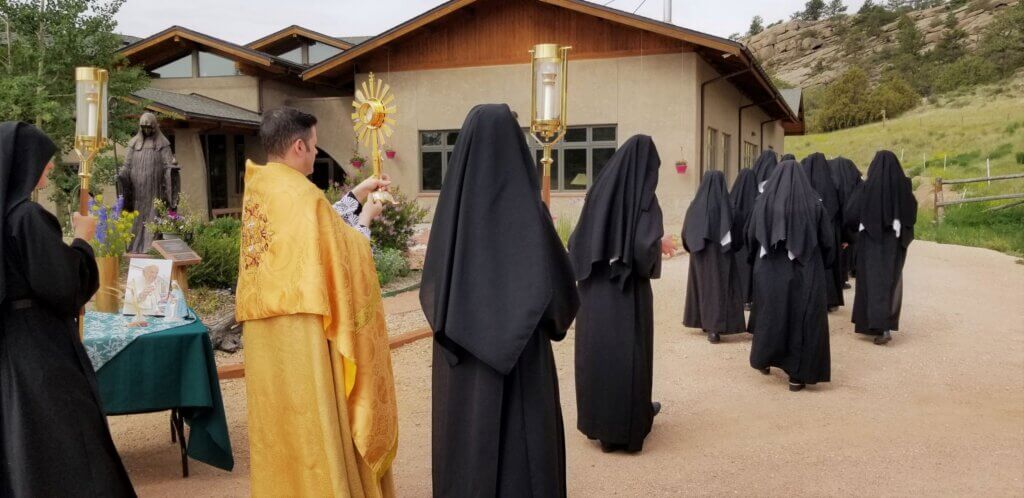
Last year’s Corpus Christi procession at the Abbey of St. Walburga
St. Walburga’s Oil

Every year on October 12 the holy oil from Saint Walburga’s tomb in Germany begins to flow, and it continues until her Feast Day on February 25. Due to the testimonies of many people who have experienced God’s healing power after anointing themselves with the oil and asking Saint Walburga to pray for them, it seems that this quote from Saint Thérèse of Lisieux may also be applied to our patroness:

“I wish to spend my heaven in doing good upon the earth.”

Photo of Saint Walburga’s crypt at the Abtei St. Walburg in Eichstätt, taken by one of our Sisters who travelled to Germany for the Abbatial Blessing of Mother Hildegard, OSB. The images on the walls are memorial plaques depicting miracles attributed to Saint Walburga, donated by patrons in gratitude for her intercession.

Embracing the Cross

A reflection on the triumph of Love by Mother Maria Michael Newe, OSB

I was thinking about the incredible words we sing during the Divine Office on the Feast of St. Andrew: “Seeing the cross [of his own martyrdom], Andrew cried out with joy, ‘O precious cross! Truly I have always loved you, and I have desired to embrace you.’”

This is a disciple who ran away in the garden of Gethsemane—he didn’t stand by Jesus on the cross—so the greatest gift that could be given to him was another chance to stand by the cross. What did he do with it? He embraced it. He longed for that moment to tell Christ, “I love you, and I want to be with you, wherever that leads.” This is the power of the triumph of the cross. Love is the triumph of the cross. When we love enough that we no longer fear the crosses in our lives but we embrace them and we long for them because they unite us with him who has loved us beyond all love, that is the triumph of the cross. So today we celebrate that we no longer fear the cross; it is truly the exaltation. Of course we cannot do this of ourselves. St. Andrew, St. Peter, none of them, could have embraced the cross on their own, but with divine strength they could embrace and kiss it. And their suffering turned into gratitude. Yes, when we can thank God for the crosses in our life, God has triumphed. When we can see that it is Love that has given us once again the chance to prove our love, we will rejoice and say, “Amen!” and run toward it, because we have a chance to prove our love. Let us pray today that the cross may triumph in our own lives, because it will not happen on our own. It is completely divine strength.

May this Easter season bring you much joy in the resurrection of Our Lord, who suffered his cross for the love of us, that we might have a sense of the depths of his love and desire to return our love for his.

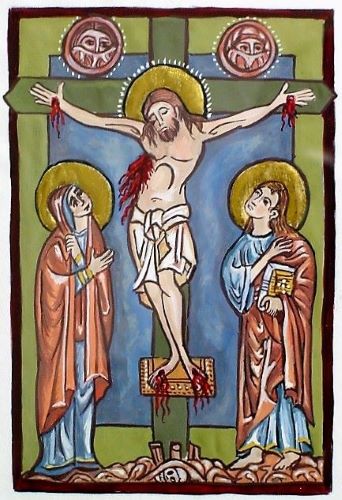
Artwork by Sr. Ancilla Armijo, OSB